Injectable and injector
- Injectable and injector
export class BaseComponent {
  protected myServiceA:MyServiceA;
  protected myServiceB:MyServiceB;
  protected myServiceC:MyServiceC;
  sharedProperty: boolean;
constructor(injector: Injector) {
    this.myServiceA = injector.get(MyServiceA);
    this.myServiceB = injector.get(MyServiceB);
    this.myServiceC = injector.get(MyServiceC);
  }
}
-
Nova forma de criar a injeção
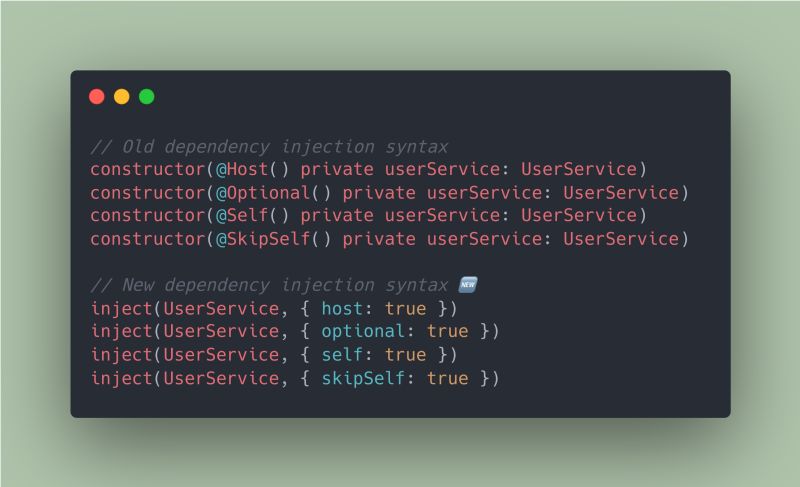
As Angular developers, we use and create services fairly often. So, in today’s post, let’s demystify the following syntax and see what the different options for it are:
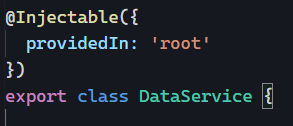
When a service is provided in the root injector (providedIn: 'root'),
it means that such a service can be injected into any component of your
application, and that service will be a singleton shared by all
consumers in your application.
If we want to restrict the scope of a service, we can provide it in a module or a component instead of the root injector. The syntax looks like this – we use the class name of the targeted module or component:
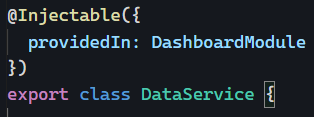
When a service is provided in a module, only the components/directives/pipes/services of that module can inject that service. However, when provided in a component, that component and its children can inject that service.
From a syntax standpoint, it’s also important to mention that using providedIn is equivalent to doing the following in a component or a module:
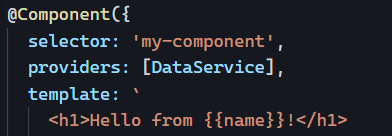
The above code is equivalent to the following:
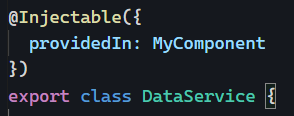
So you only need one or the other; both would be redundant.
Finally, there is another option available: platform.
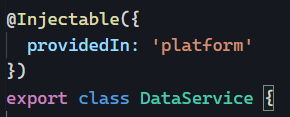
The
service would be injectable into any Angular app in the current browser
tab. It’s a rare use case, but if you’re running multiple Angular
applications on the same page and want to share a service between these
applications, platform is what you need.
For more information, you can read that post of mine that covers all these options (note: providedIn: 'any' used to be an option but is now deprecated, which is why I didn’t mention it)